Views: 0 Author: Site Editor Publish Time: 2026-11-10 Origin: Site


High-volume apparel manufacturing relies on absolute precision to remain competitive and profitable. Yet, dimensional discrepancies between the top and bottom plies of a fabric spread routinely compromise entire production runs. You might find the top layer cuts perfectly to the pattern. Meanwhile, the bottom layer shifts or distorts drastically. This hidden divergence causes poor garment fit. It also increases downstream sewing time and elevates expensive scrap rates.
Production managers often blame operators or software for these frustrating flaws. However, the root cause is almost always mechanical. When you understand the physics of blade drag, you can make better purchasing decisions. We will show you exactly what matters most.
This guide breaks down the physical mechanics behind ply shifting and blade deflection. We will detail exactly how to evaluate modern cutting room technology. You will learn how to upgrade your equipment properly. These insights help you resolve costly inconsistencies and protect your margins from the very first cut.
The Root Causes: Top/bottom discrepancies are primarily caused by blade deflection (bending under pressure) and uneven vacuum compression across the spread depth.
Material Variables: Slippery synthetics, high-loft materials, and fusible fabrics behave differently under blade drag, exacerbating layer-to-layer friction.
Technology Solutions: Upgrading to a modern multi-layer fabric cutting machine with intelligent knife control and variable vacuum hold-down systems is the most reliable way to enforce dimensional stability from ply 1 to ply 100.
Business Impact: Eliminating these discrepancies directly improves fabric yield, reduces operator intervention, and accelerates sewing assembly times.
Defining the exact mechanical failures helps us understand why top and bottom layers diverge. You cannot fix a discrepancy until you map the physical forces acting on the fabric. Three primary mechanical issues disrupt multi-ply precision.
A reciprocating blade drives deep into a thick fabric spread. Resistance builds instantly as it pushes through dense fibers. The blade lacks lateral support midway through the cut. It naturally bends away from the intended cut line. Engineers call this deflection. It forces the bottom layers to be cut larger or smaller than the top layers. Yaw occurs when the blade twists slightly off its vertical axis. This twisting motion creates angled edges. Sewing operators then struggle to align these distorted panels accurately.
Vacuum tables stabilize the spread during operation. However, suction does not distribute evenly across thick spreads. Bottom layers sit closest to the vacuum surface. They remain highly compressed and incredibly rigid. Top layers sit much further away. They experience less direct suction force. They can easily ripple or shift under the intense drag of the oscillating blade. When the top layers lose compression, they float. Floating fabric guarantees misaligned pattern shapes.
Smooth or coated fabrics lack natural surface friction. They cannot grip one another securely. When the blade penetrates the material, it creates aggressive friction. Its downward and upward motion pulls layers violently. The top and middle layers slide out of alignment. This happens before the cut even finishes. High-loft materials like fleece act like sponges. They compress inconsistently, allowing middle layers to creep outward. Understanding these material behaviors is crucial for troubleshooting discrepancies.
Assuming blade sharpness alone prevents deflection.
Ignoring the density differences between natural and synthetic fibers.
Failing to monitor vacuum pressure gauges during long cutting runs.
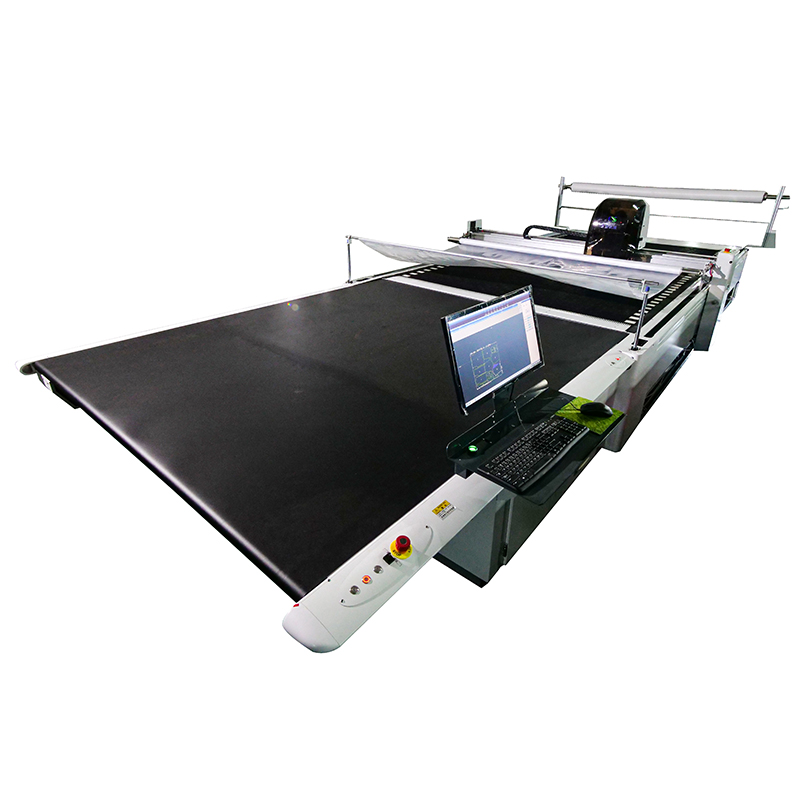
Production managers must audit their current equipment against expected performance baselines. Older technology often lacks the sensory feedback required for modern precision. Recognizing these hardware limitations helps justify necessary upgrades.
Basic equipment uses pure mechanical oscillation. These older machines completely lack intelligent sensors. They cannot detect blade bending in real time. Operators must manually slow down cut speeds. This manual intervention is the only way to maintain accuracy on bottom layers. Slower speeds destroy production efficiency. Upgrading to a modern Fabric cutting machine eliminates this manual guesswork. It automates speed adjustments to preserve both precision and throughput.
Older units rely heavily on static vacuum systems. The suction pressure remains strictly constant. As the cutting head moves, operators remove finished pieces. The spread area decreases rapidly. If the vacuum cannot dynamically adjust, holding force drops drastically. The top layers will eventually fail and shift. A static vacuum bleeds air through exposed areas. This bleed starves the remaining uncut fabric of essential compression.
A degraded cutting bed ruins your entire foundation. Bristles get cut, bent, and tangled over time. The bottom ply no longer lies perfectly flat. It rests on a wavy, spongy surface. Precision becomes completely impossible. Sharp blades cannot fix a damaged base. Operators often overlook the cutting bed during routine maintenance. They focus entirely on the knife. You must evaluate bristle wear systematically to ensure consistent bottom-layer support.
Buyers looking to upgrade their cutting room face complex choices. You must separate marketing claims from actual mechanical capabilities. Focus strictly on features preventing blade deflection and maintaining vacuum integrity.
Look for highly intelligent systems. They use real-time sensors mounted near the cutting head. These sensors measure blade deflection instantly. The machine automatically adjusts the knife angle. It modifies pitch and yaw simultaneously to compensate. This constant micro-correction ensures a true 90-degree cut through every single layer. Investing in a multi-layer fabric cutting machine guarantees this exact technological capability. It removes operator error entirely.
You need variable frequency drives (VFD). These drives manage vacuum motors intelligently. They concentrate suction directly under the active cutting head. They also seal cut areas automatically. This maintains top-ply rigidity throughout the entire process. Dynamic management prevents air bleed. It also reduces electrical consumption significantly. VFD systems adjust motor RPMs based on real-time suction demand.
Synthetic materials melt exceptionally easily. High-speed blade friction creates intense heat. This heat fuses the cut edges of bottom layers together. Fused edges destroy downstream sewing efficiency. Programmable misting mechanisms lubricate and cool the blade. Chilling systems are mandatory evaluation criteria for technical textiles. They prevent nylon and polyester blends from welding into solid blocks.
Blade oscillation speed must adjust independently. The machine's forward travel speed is a separate variable. Controlling both prevents fabric drag on delicate top layers. You can slow the oscillation for heat-sensitive fabrics. You can speed it up for dense, natural fibers. Independent control provides the ultimate flexibility for diverse production runs.
Table: Core Cutting Machine Capabilities Comparison
Capability | Traditional Equipment | Modern Intelligent Equipment | Primary Production Benefit |
|---|---|---|---|
Knife Control | Mechanical oscillation only | Active sensor feedback (Pitch/Yaw) | Ensures true 90-degree cuts across all plies. |
Vacuum System | Static suction | Variable Frequency Drives (VFD) | Maintains constant compression on top layers. |
Temperature Control | None or manual silicone spray | Automated misting and chilling | Prevents bottom layers of synthetics from fusing. |
Stroke Speed | Fixed ratio to forward speed | Independently variable speeds | Eliminates top-layer drag on delicate fabrics. |
Hardware alone never solves entrenched process errors. Mitigating deployment risks requires matching the machine strictly to your materials. You must understand how your specific fabrics interact with automated equipment.
Vendors quote maximum spread heights aggressively. They might promise 5cm or 7cm compressed heights. You must test your specific materials before believing these numbers. Cutting 7cm of heavy denim requires specific blade profiles. It demands aggressive sharpening intervals. Cutting 7cm of delicate silk behaves vastly differently. Silk requires gentle oscillation and maximum vacuum hold-down. Never assume a machine cuts all fabrics equally at maximum height.
A poorly tensioned spread destroys cut quality instantly. Even the most advanced apparel cutting machine cannot fix stretched fabric. Stretched fibers snap back after cutting. This shrinkage ruins panel dimensions. You must review your automated spreading machines thoroughly. Ensure the fabric lays completely tension-free before cutting begins. Allow proper relaxation time for elastane blends. Spreading is the absolute foundation of cutting precision.
High-precision cutting requires rigorous, non-negotiable maintenance. Blades must stay razor-sharp to prevent deflection. You must replace sharpening stones regularly to maintain the optimal blade bevel. Bristle blocks wear down consistently under heavy production. You should forecast the exact cost and frequency of these replacements. Tracking these consumable expenses ensures you never compromise cut quality to save minor maintenance costs.
Always allow elastane and spandex blends to relax for 12-24 hours prior to spreading.
Use paper underlayments for exceptionally slippery fabrics to increase base friction.
Monitor the humidity in your spreading room to control static electricity buildup.
Procurement teams need concrete data to justify capital expenditures. You must transition the conversation from machine features to financial returns. Focus on scrap reduction and downstream labor efficiency.
Calculate your current fabric waste carefully. Look closely at bottom-ply rejects. Measure the enforced buffer zones between pattern pieces. Operators often add millimeters of buffer to compensate for anticipated blade deflection. Precision cutting enables incredibly tighter nesting. Zero-buffer cutting saves massive amounts of raw material. Over a year, saving three millimeters per piece translates to thousands of yards of reclaimed fabric.
Mismatched panels create massive hidden labor costs. Sewing operators struggle to align distorted edges. Document the exact time they spend easing or stretching mismatched top and bottom panels. Perfect cuts eliminate this wasted effort entirely. Assembly times drop significantly. Quality control rejections decrease. The sewing floor runs smoothly when they receive perfectly identical parts from the cutting room.
Never purchase machinery based solely on glossy spec sheets. Demand a rigorous live cutting trial. Use your most notoriously difficult fabric for this test. Run the trial at your standard daily ply height. Physically measure the top and bottom plies of the resulting cut parts. Check the corners for distortion. Inspect the notches for depth consistency. A reputable vendor welcomes this physical validation.
Discrepancies between top and bottom fabric layers are never an inevitable cost of doing business. They represent distinct mechanical failures caused by blade deflection, poor vacuum hold-down, and unmanaged friction. Accepting these flaws drains your profitability daily.
By evaluating and investing in a purpose-built multi-layer fabric cutting machine equipped with active knife intelligence and dynamic vacuum control, apparel manufacturers regain total control. This technology allows you to eliminate scrap effectively. You can tighten nesting tolerances safely. Most importantly, you protect your margins at the very start of the production line. Take action today by auditing your current cutting room waste metrics. Schedule a live material test with a modern equipment vendor to see the precision difference firsthand.
A: Blade lifespan varies heavily by material and machine usage. Abrasive synthetics dull blades much faster than natural cotton. However, precision issues often stem from worn sharpening stones rather than the blade itself. Automated machines should be programmed to sharpen at regular intervals based on cut perimeter distance. Replace blades immediately when visual deflection occurs despite frequent sharpening.
A: Software can optimize the cutting path efficiently. For example, it can cut sharp corners in multiple intersecting strokes rather than pivoting the blade. This approach reduces overall blade drag. However, software cannot correct physical blade bending mid-stroke. True correction requires hardware-level active knife control and sensor feedback.
A: High-speed blade oscillation generates severe friction. This creates intense heat at the bottom of the spread where pressure is highest. This concentrated heat quickly melts synthetic fibers like polyester and nylon. The solution involves slowing the oscillation speed, using a specialized low-friction blade profile, or integrating an automated blade cooling system.


