Views: 0 Author: Site Editor Publish Time: 2026-07-08 Origin: Site


The packaging industry is rapidly shifting away from manual cutting, die-cutting, and laser methods. Manufacturers now rely heavily on specialized CNC technology to produce precision packaging inserts for flight cases, product presentations, and protective shipping. However, cutting foam is notoriously tricky. Choosing the wrong equipment often leads to melted edges, excessive dust, shredded material, and poor dimensional accuracy. You need a reliable technical framework to navigate these challenges.
This guide provides a vendor-neutral evaluation strategy. It will help production managers and packaging engineers select the exact equipment they need without overpaying for unnecessary features. You will discover how specific material properties demand distinct cutting mechanisms. We will explore the critical differences between routing and oscillating knife technologies. Finally, you will learn exactly which machine specifications matter most for yield and edge finish. By the end, you will possess a clear roadmap to upgrade your production floor confidently.
Material dictates technology: Dense EVA and PE foams require different cutting approaches than soft polyurethane.
Blade over bit: For most packaging applications, oscillating knife technology outperforms traditional rotary routers by eliminating dust and preventing melted edges.
Throughput multiplier: A Double Head Oscillating Knife Cutter can drastically reduce cycle times for high-volume insert production.
Hold-down is critical: Without a high-flow vacuum table, lightweight foam will shift, ruining cut tolerances regardless of machine quality.
Before evaluating hardware, you must define the exact production requirements on your shop floor. Foam behaves unpredictably under mechanical stress. You cannot treat it like wood or aluminum. Identifying your primary materials and volume expectations sets the foundation for a successful equipment purchase.
Different packaging foams react uniquely to cutting forces. You must match the machine parameters to the cellular structure of your specific substrates.
Dense Foams (EVA, EPE): Ethylene-vinyl acetate (EVA) and expanded polyethylene (EPE) are rigid and durable. They protect heavy, high-value equipment like cameras or industrial tools. These dense materials require high machine rigidity. They also demand specific blade geometries to prevent edge tearing during rapid directional changes.
Soft Foams (Polyurethane/Sponge): Polyurethane is highly porous and prone to compression. Standard cutting methods often squash the material before slicing it. This creates distorted, wavy edges. Processing these substrates requires specialized parameters. A dedicated Sponge Cutting Machine maintains the material shape during the cut by using ultra-sharp blades and precisely calibrated vibration frequencies.
You must assess your daily throughput requirements. Are you running a high-mix, low-volume operation? Custom case inserts require frequent design changes. In this scenario, fast software integration and quick tool changes matter most. Conversely, continuous high-volume production demands multi-head systems. Scalability relies on maximizing output per square meter of your facility.
Define your acceptable quality limits upfront. Poor machine calibration leads to immediate product rejection. Unacceptable outcomes include "fuzzing" along the cut path. Scorch marks frequently occur when utilizing laser cutters. Tapered edges happen when a blade flexes under pressure. Your success criteria must include perfectly vertical walls and clean, dust-free edges.
The fundamental debate in foam processing revolves around the cutting mechanism itself. You generally choose between spinning a bit or vibrating a blade. Each technology serves distinct operational needs.
Rotary spindle machines mill material away to create shapes.
Pros: Routers excel at processing extremely dense foams. They can easily mill 3D pockets, creating varying depths within a single foam block. This proves highly useful for custom tool shadows.
Cons: Spinning bits generate massive amounts of static-cling dust. This debris coats the machine and contaminates the workspace. Furthermore, friction creates heat. If you calculate feeds and speeds incorrectly, the router bit will melt the foam, ruining the insert.
Oscillating knives represent a massive leap forward for packaging applications. They slice the material rather than grinding it away.
Mechanism: This technology uses a rapidly vibrating blade, driven by pneumatic or electric motors. It moves up and down thousands of times per minute while traveling along the cut path.
Pros: The process produces zero dust. It leaves extremely clean, smooth edges. The slicing action prevents heat accumulation, entirely eliminating the risk of melted foam. Because of these advantages, it has become the industry standard for any modern CNC Cutter Machine handling protective packaging.
Production facilities often outgrow single-head machines. Scaling up requires advanced tooling configurations. Enter the Double Head Oscillating Knife Cutter. By equipping dual cutting heads, the machine processes symmetric parts simultaneously. You effectively double your throughput on a single gantry without expanding the machine footprint.
The chart below outlines how these two primary technologies compare across key packaging metrics.
Feature | CNC Router | Oscillating Knife |
|---|---|---|
Cutting Mechanism | Rotary milling (Bit) | High-frequency vibration (Blade) |
Dust Generation | Extremely High | None |
Heat Accumulation | High (Risk of melting) | Low to None |
Best Application | 3D pocketing, ultra-dense foams | Clean 2D profiles, zero-dust environments |
Edge Quality | Fair (May require secondary cleanup) | Excellent (Smooth, vertical walls) |
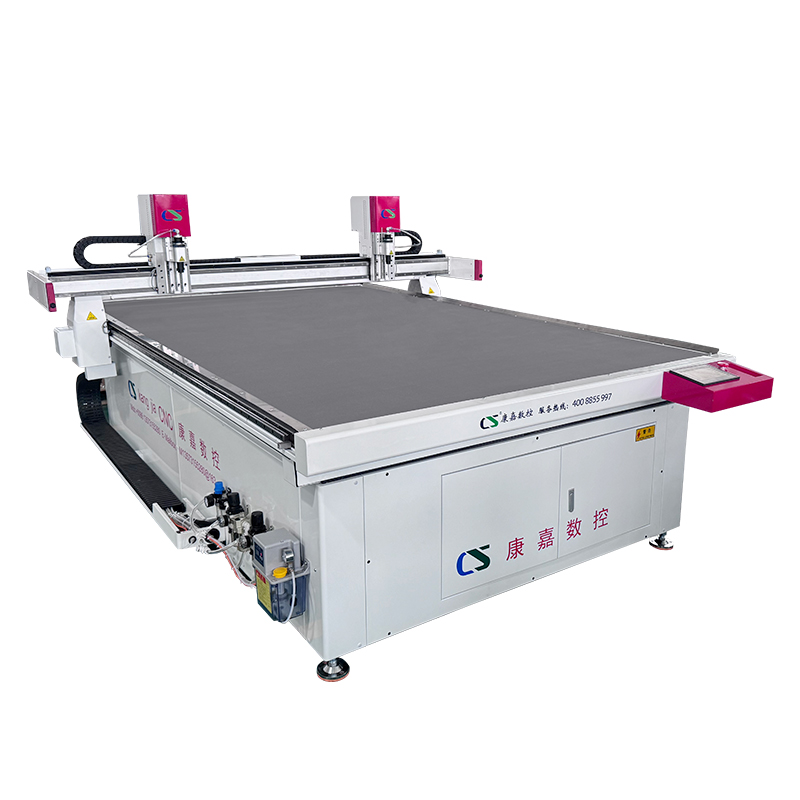
Beyond the core cutting technology, specific mechanical features dictate the success of your operation. When reviewing a Foam Cutting Machine, pay close attention to the following subsystems. They separate professional equipment from hobbyist tools.
Foam is highly porous and exceptionally lightweight. It wants to move. If the material shifts during a cut, your tolerances disappear, and scrap rates spike. You must evaluate machines offering zone-controlled vacuum tables. A robust high-flow vacuum pump sucks the foam down firmly against the table. Zone control allows you to concentrate suction precisely where the material sits, maximizing holding force.
Packaging inserts require significant thickness to absorb shock. Standard flatbed machines often max out at 50mm to 100mm of clearance. Thick protective packaging frequently demands a CNC Cutting Machine built with an extended Z-axis. Look for equipment offering 150mm or more of clearance under the gantry to accommodate deep foam blocks.
Modern packaging designs often require more than just a straight cut. You might need V-cuts for folding hinges, or a pen tool to mark part numbers. Prioritize machines featuring automatic tool changing (ATC) or multi-tool heads. Mounting an oscillating knife, a bevel blade, and a marking tool simultaneously eliminates manual intervention. This dramatically reduces cycle times.
Hardware is only half the equation. You must evaluate CAD/CAM software compatibility. Foam blocks represent a significant material expense. High-end nesting algorithms automatically arrange your part files to utilize every available millimeter of the raw material. This optimization reduces foam waste drastically. Tightly nested parts directly impact your bottom line by lowering ongoing material costs.
Purchasing the equipment does not instantly guarantee perfect production. Transitioning to automated digital cutting introduces several operational realities. Recognizing these risks early allows you to train your team and adjust workflows proactively.
Every new material requires a calibration phase. You must dial in the correct parameters. Running an oscillating knife too fast tears the foam cells, leaving jagged edges. Conversely, running a traditional router too slow generates excessive friction, instantly melting the substrate. Production managers must allocate time for testing and documenting these specific feeds and speeds before running live orders.
Knives eventually dull. Standard steel blades dull quickly when cutting dense EVA. You must budget for consumable replacements. Upgrading to tungsten carbide blades costs more upfront, but they last significantly longer. Track blade lifespans carefully. Replacing a blade too late results in tapered cuts and rejected parts. Changing them proactively ensures consistent quality.
Moving away from manual band saws or simple 2D die-cutting requires upskilling your workforce. Programmable multi-head systems require basic CAD/CAM literacy. Operators need to understand vector files, toolpaths, and machine origin points. Furthermore, they must master basic preventative maintenance. Cleaning filters, lubricating rails, and inspecting pneumatic lines keep the equipment running smoothly.
Building a business case for new equipment requires looking beyond the sticker price. You must weigh the financial implications of modernizing your production line against the inefficiencies of your current methods.
Evaluating financial impact means balancing the upfront capital required for a premium machine against long-term operational savings. A high-quality machine demands a higher initial investment. However, it rapidly offsets this cost. You will save on manual labor hours. Nesting software drastically reduces material scrap. Furthermore, digital cutting completely eliminates the expensive, time-consuming process of manufacturing physical steel rule dies for every new custom design.
A machine sitting idle while waiting for parts destroys your production schedule. When shortlisting vendors, prioritize manufacturers offering localized support networks. Ensure they maintain readily available inventories of replacement blades, vacuum pumps, and electronic components. Review their maintenance schedules for transparency. Reliable support proves just as crucial as mechanical performance.
Never buy a machine based purely on a brochure. Always request a physical sample cut. Send the manufacturer a block of your most challenging, specific foam material along with a complex vector file. Inspect the returned sample for vertical edge accuracy, corner sharpness, and surface finish. This real-world test provides the best proof of capability before you finalize any purchase agreement.
Selecting the ideal equipment for foam packaging requires moving past basic specifications. You must focus intently on material compatibility, edge quality requirements, and critical vacuum mechanics. A machine perfectly suited for dense EVA might struggle heavily with porous polyurethane. By prioritizing oscillating knife technology and robust vacuum hold-down systems, you guarantee clean, accurate, and repeatable parts.
Audit your current production line today. Track your daily foam scrap rates carefully. Identify where manual cutting or outdated die-cutting creates bottlenecks. Use this data to build a solid, evidence-based business case for digital CNC adoption. The right equipment will elevate your packaging quality, streamline your workflow, and rapidly generate a return on your investment.
A: Yes, but it requires careful execution. You must use specialty foam-cutting end mills, such as upcut or downcut spirals. Precise spindle speed control is mandatory to avoid melting the material. Additionally, because routers generate massive amounts of static-cling debris, you will need highly aggressive dust collection systems.
A: An oscillating knife or a specialized sponge cutting machine remains the preferred choice. Soft, porous polyurethane tends to compress under pressure. Rotary router bits often grab and shred this material. A rapidly vibrating blade slices through the sponge cleanly without distorting its shape.
A: This depends entirely on the blade length and the pneumatic stroke of the tool head. Typical heavy-duty oscillating knives can cleanly cut foam up to 50mm to 100mm thick. For blocks thicker than this, specialized hot-wire systems or band blade setups may become necessary to maintain vertical accuracy.


