Views: 0 Author: Site Editor Publish Time: 2026-07-16 Origin: Site


Leather manufacturing faces a persistent and frustrating struggle. You must constantly balance expensive raw materials against highly inefficient production methods. Manual cutting drains time and ruins your profit margins. Die-punching lacks flexibility for custom runs. Laser cutting causes severe thermal damage to natural hides. Scaling your production requires a definitive operational shift. You must move away from relying on skilled manual labor. You must abandon rigid die-cutting setups. Dynamic digital manufacturing offers a much better path forward. Upgrading to a CNC Cutting Machine delivers verifiable returns. It increases your overall material yield significantly. It guarantees pristine edge quality across every batch. It also automates your entire production workflow. However, this holds true only if you choose wisely. Your equipment must align perfectly with your specific production volumes. It must also handle your exact material types seamlessly. We will explore how to evaluate these modern systems effectively.
Digital nesting and automated cutting typically improve raw leather yield by 5% to 15% compared to manual methods, directly impacting gross margins.
Unlike thermal processes, a tangential knife leather cutter produces clean, unburnt edges ready for immediate assembly or edge-painting.
Advanced systems utilizing a CCD leather cutting machine configuration automatically identify natural hide flaws and adjust cut paths to avoid defects.
Successful implementation requires factoring in vacuum workholding capabilities, CAD/CAM software integration, and operator training.
Traditional leather cutting methods hide massive inefficiencies. These hidden expenses erode your bottom line before production even begins. Physical die creation takes several days. Ordering new steel rule dies for every design iteration slows down your time-to-market. Storing these heavy physical dies consumes valuable factory floor space. You cannot iterate designs quickly. You cannot adjust sizing on the fly. Digital manufacturing removes these physical constraints completely. You simply load a new vector file and begin cutting immediately.
Material yield represents another harsh reality. Natural leather features highly irregular perimeters. It contains unpredictable organic flaws. You will find scars, bug bites, and stretch marks across almost every hide. Synthetic cutting methods assume uniform rolls of flawless material. Applying standard synthetic approaches to natural hides creates massive waste. Manual cutters often leave excessive gaps between patterns to play it safe. Digital nesting algorithms pack patterns tightly together. They calculate the absolute best fit mathematically.
Relying heavily on manual labor creates severe operational risks. Master leather cutters are increasingly rare. Training new staff takes years of trial and error. Human workers naturally experience fatigue during long shifts. Their cutting consistency drops as the day progresses. You risk producing flawed parts. Hand injuries also present a constant liability on the factory floor. Scaling your output becomes nearly impossible. You cannot simply hire ten more master cutters overnight. Digital equipment standardizes your output quality immediately.
Audit your current die storage costs. Calculate the time lost waiting for new physical dies. Compare this directly against the instantaneous setup time of digital cutting files. You will likely uncover significant hidden savings.
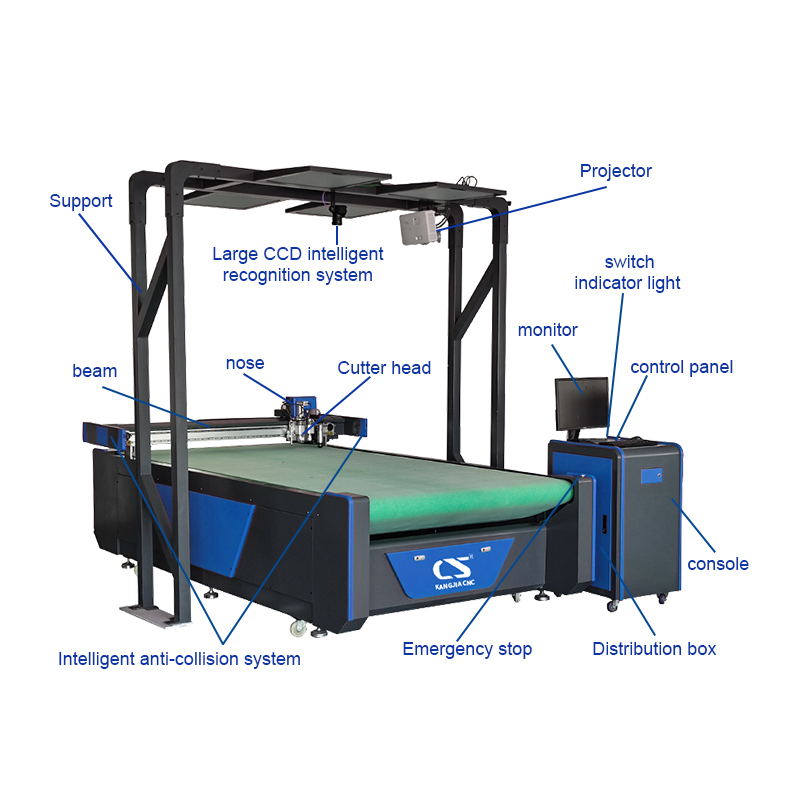
Modern digital cutting systems eliminate the guesswork from processing natural hides. The most impactful innovation involves automated flaw detection. Advanced setups use a CCD Leather Cutting Machine configuration. Overhead projection systems and high-resolution cameras transform the workflow. Here is how the system typically operates:
Operators lay the irregular hide flat on the vacuum table.
The high-definition camera scans the complete perimeter of the hide.
Operators use digital pens or physical markers to circle scars and defects.
The camera recognizes these marked zones as restricted cutting areas.
The software algorithm instantly re-nests all required patterns around the flaws.
This dynamic process maximizes your material yield automatically. It ensures no defective leather ends up in your final product.
Edge quality dictates the final look of premium leather goods. Using a standard drag knife on thick leather often pulls the material. This stretches the corners out of shape. A Tangential Knife Leather Cutter solves this mechanical problem completely. The machine physically lifts the blade out of the material at sharp corners. It rotates the blade to the new vector angle. It then plunges back down to resume cutting. This motorized turning prevents corner distortion entirely. It produces exceptionally clean edges on thick vegetable-tanned leathers. For softer or thicker materials, oscillating tools provide a rapid sawing motion. Punching tools handle automated hardware hole placement perfectly.
Throughput improvements redefine what a small team can accomplish. We can quantify these speed increases easily. Cutting a complex 30-piece upholstery set manually might take an hour. The digital system completes the same exact job in under five minutes. You can scale your daily production volume without expanding your workforce. You simply feed the machine continuously.
Many manufacturers initially consider laser cutters due to their fine detail capabilities. However, lasers introduce a massive thermal edge problem. Lasers burn their way through the material. This process chars the edge of the leather. It leaves a hardened, brittle crust along every cut line. It also generates an incredibly strong, unpleasant odor. You must subject the cut pieces to secondary cleaning processes. You have to sand or wipe down the edges before applying edge paint.
Precision and distortion present another critical issue. Lasers apply intense localized heat. Heat easily shrinks certain leathers, particularly chrome-tanned varieties. This micro-shrinkage ruins the dimensional accuracy of your parts. CNC cutting equipment applies direct physical force instead. Knives slice through the fibers cleanly. They eliminate thermal distortion entirely. Your parts remain exactly true to their digital CAD dimensions.
Maintenance routines differ wildly between these two technologies. Lasers require expensive glass or metal tubes. They demand heavy-duty fume extraction systems to handle the toxic smoke. These extractors need frequent, costly filter replacements. Conversely, knife systems rely on simple physical consumables. You only replace small tungsten carbide blade inserts and breathable cutting mats. The physical replacement process is fast and straightforward.
Comparison Chart: Cutting Technologies
Feature | CNC Knife Cutting | Laser Cutting |
|---|---|---|
Edge Quality | Clean, raw, unburnt edges. Ready for paint. | Charred, hardened, darkened edges. Needs cleaning. |
Dimensional Accuracy | High. No heat distortion or shrinkage. | Variable. Heat causes micro-shrinkage in chrome-tanned leather. |
Environmental Impact | No smoke. Minimal dust. | Toxic fumes. Strong odors. Requires heavy extraction. |
Consumable Types | Carbide blades, plastic underlay mats. | Laser tubes, mirrors, lenses, carbon filters. |
Integrating a new digital system involves more than just plugging it in. Workholding challenges represent a common point of failure. Natural hides are highly breathable and notoriously uneven. Securing them during high-speed cutting is difficult. Standard clamps do not work. You need powerful, multi-zone vacuum tables. These tables suck the leather flat against the bed. You must also use breathable underlays. These porous mats allow the vacuum to pull through them. They prevent the material from shifting while the knife drags across the surface.
Do not underestimate the software learning curve. Avoid vendors promising absolute "plug and play" simplicity. Your operators must undergo a technical transition. They will move away from making physical cardboard patterns. They must learn digital CAD/CAM software. They need to understand algorithmic nesting parameters. Setting up toolpaths requires basic computer literacy. You must factor comprehensive operator training into your implementation timeline.
Your physical footprint and infrastructure require careful planning. Full-hide processing demands significant floor space. The machine itself is quite large. You also need clearance around the machine for loading and unloading materials. Electrical requirements are strict. These machines typically require reliable three-phase power. You will also need dedicated compressed air systems. The vacuum pumps and pneumatic tool heads rely on clean, dry compressed air to function properly.
Many shops fail to upgrade their electrical panels before the machine arrives. Verify your three-phase power availability and air compressor capacity weeks in advance. Waiting until delivery day causes unnecessary downtime.
You must match the machine specifications directly to your hide sizes. Evaluate the working area dimensions carefully. If you produce small leather goods from half-hides, a compact bed suffices. If you manufacture automotive interiors or large furniture pieces, you need a massive cutting bed. Trying to process full hides on a machine that is too small ruins your efficiency. It forces you to pre-cut the material manually, defeating the purpose of automation.
Audit the manufacturer's modular tool head offerings. Your current product line might only require a basic drag knife. However, future designs might use thicker, rigid materials. Ensure the CNC Cutting Equipment accepts various attachments. Look for systems that support oscillating knives, punching units, and marking pens. A modular tool head allows you to swap tools quickly. It future-proofs your production floor against changing fashion trends and material types.
Vendor support dictates your long-term success. Hardware eventually breaks. Software occasionally glitches. Emphasize the importance of localized technical support. Check their spare parts availability. Proprietary controller boards and specialized vacuum components must be stocked locally. Investigate their remote diagnostic capabilities. A good vendor can log into your Leather Cutting Machine remotely. They can often fix software configuration errors in minutes. This keeps your production line moving smoothly.
Transitioning to digital cutting represents a pivotal moment for any leather manufacturer. A modern cutting machine serves as a highly strategic asset. It is specifically designed to eliminate manual bottlenecks. It rescues your material margins through algorithmic nesting. Most importantly, it standardizes your product quality across every single batch. You regain control over your production timeline.
Before initiating any procurement process, take concrete action. Advise your decision-makers to request a formal time-and-yield study from your shortlisted vendors. Send them your actual digital CAD files. Ship them samples of your physical leather hides. Demand to see real-world cutting results on your specific materials. This evidence-based approach guarantees you select the exact equipment your facility truly needs.
A: It depends on the tool and material density. Standard drag knives easily handle leathers up to 3mm thick. If you use a high-frequency oscillating knife, the machine can cut dense, heavy leathers ranging from 6mm to 15mm thick. Always match the tool power to your thickest hide.
A: Yes. These machines are highly versatile. Synthetics and fabrics lack natural flaws, making them incredibly easy to process. If your machine features the correct oscillating tool and a strong vacuum setup, you can perform multi-ply cutting to process several layers of fabric simultaneously.
A: Timelines vary based on your production volume and material hardness. High-volume shops cutting tough vegetable-tanned leather may change blades every few days. Cutting softer materials extends blade life to weeks. Never use dull blades; they compromise edge quality and stretch the material.
A: The industry relies heavily on standard vector formats. Most cutting software seamlessly imports DXF, PLT, and AI files. This broad compatibility ensures you can easily integrate the cutting machine with your existing pattern design software without expensive workarounds.


